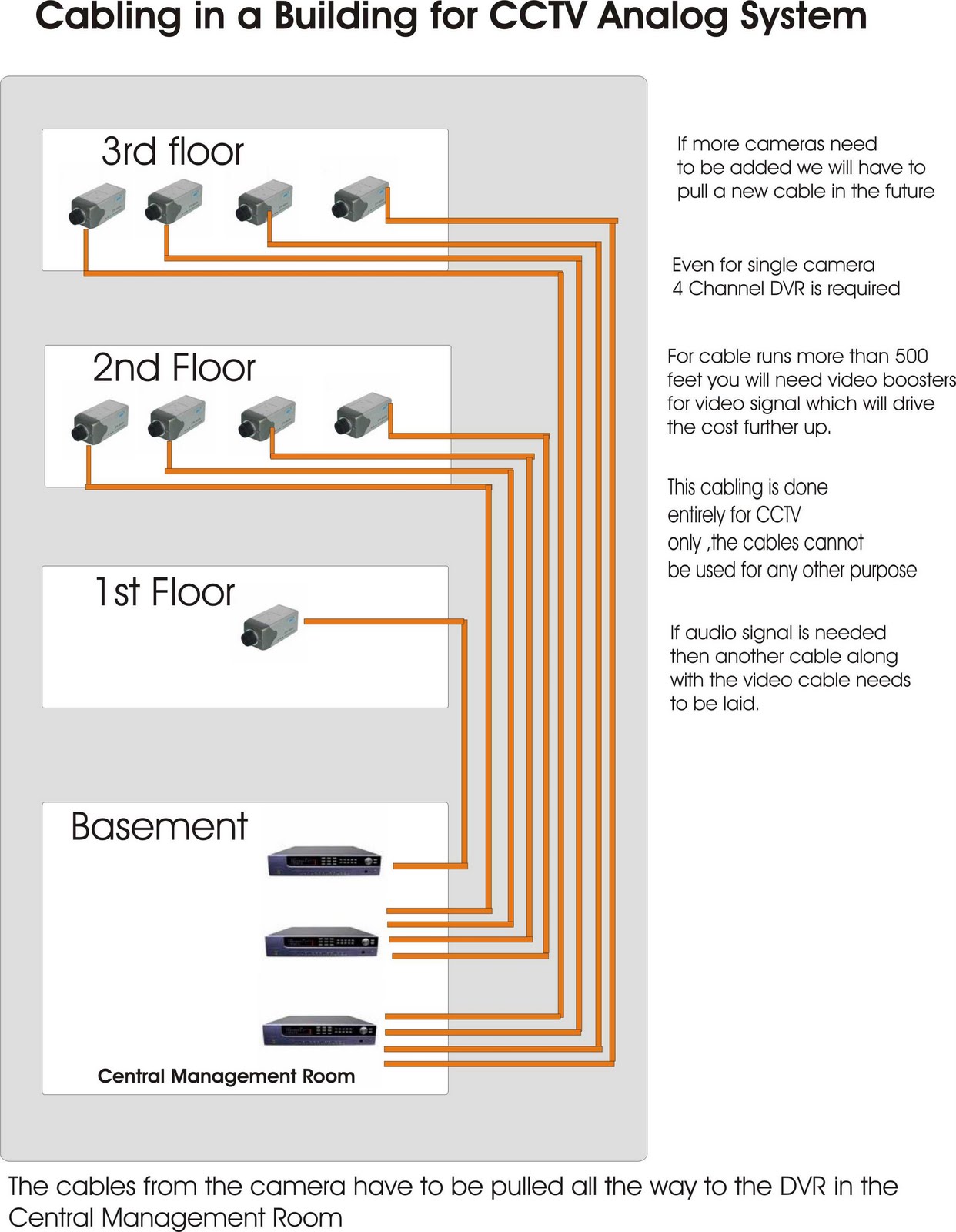
You can see the large density of cables in an Analog Camera setup.Also due to the long distance between the DVR and the cameras boosters will be required and quality of video will be degraded
Only a single fibre or Cat - 6 cable needs to run from the top of the building to the bottom and no cabling mess required.Also the solution is flexible and easily scalable. Other services can also be operated through the same fibre cable.
Friday, 7 May 2010
Thursday, 6 May 2010
Thief Caught on Camera,Mumbai,India
A bakery in the Western Suburbs of Mumbai,India was installed with 20 IP cameras FDLIV7131 . All the cameras were connected using POE switches and setup for 24 hour recording.
Due the high quality of the video is was very easy to record the face of the thieves in the video who were later caught by the police.They stole a mobile phone from an unsuspecting victim. Please have a look at the video.
Now with Megapixel IP Cameras you can zoom into the recorded video and get much better detail and see faces of people standing in a distance.
We now have a new range of 2 Megapixel cameras coming up and will be able to offer 5 megapixel cameras to you by June.
For such solutions for your premises do feel free to contact us.
Tuesday, 27 October 2009
Are IP Cameras Cheaper than Analog Cameras
| 4 IP Camera System | DVR + 4 Analog Camera System |
| Cost of Night Vision IP Camera with MPEG-4 and MJPEG compression. Rs.10,000 | Cost of Analog Camera Night Vision with equivalent quality of IP Camera Rs.5,000 |
| No DVR is required. You can use an existing computer since a 4 channel recording software comes free with the IP Camera | DVR required for recording. Cost of a 4 channel DVR with a Hard drive would be approx Rs.20,000 |
| Since you are using a computer you will already have an existing monitor | Since you have bought a DVR you will have to buy another monitor or TV to see the output.approx Rs.3000. If you have an existing TV then you can use the RGB input. |
| The wire for IP Camera is simple CAT – 5 or LAN wire which costs about Rs.11 per m. Consider atleast 50m cable for all cameras Cost Rs.550 (for longer cable runs the cost will increase drastically for analog cameras) | The wire required for analog video which will have to be pulled all the way to the DVR from wherever the camera is installed is Rs.30 per m Consider atleast 50m cable for all cameras Cost Rs.1500 (this is a hidden cost which most people don’t realize and come to know only after the installation. |
| You will get video and audio from all 4 channels and will be able to record video and audio simultaneously. | Most DVR’s support only single channel audio. |
| After an Electricity failure the IP Cameras will come on and will be available immediately over the network for you to view remotely. | The DVR has a soft button and has to be booted every time the electricity goes. You will not be able to view the cameras remotely until the DVR is rebooted. However the recording will stop in both cases(IP and Analog) until the systems are rebooted. |
| Total : 40,550 plus taxes(approx) | Total : Rs.44,500 plus taxes(approx) |
However if you need to purchase a new computer the cost of the IP Camera System will be higher
by about Rs.10,000 but however as the IP Camera System has far many advantages over an
Analog/DVR system the extra cost will be worth it.
For More information visit www.livedarshan.com
Converting Analog CCTV to IP Surveillance
Converting Analog CCTV to IP Surveillance - by www.livedarshan.com
CCTV has traditionally been recorded to VCRs (video cassette recorders), and because of its perceived ease of use and manageable price point, analog was probably the right choice at the time of purchase. However, the rise of digital has laid bare analog’s many shortcomings. Analog CCTV systems are generally maintenance intensive, offer no remote accessibility, and are notoriously difficult to integrate with other systems. Despite these obvious deficiencies, the end user who has invested in cameras, cables, and more, and is satisfied with the current quality is right to ask, "Why buy new equipment?"Implementing a digital system does not require throwing away those trusted (and already paid-for) cameras. With IP-Surveillance, you can still use all the cameras, lenses, and cables in place through this step-by-step migration to digital technology. And if this is not enough reason to seriously consider an upgrade, examine the TLV, or time-lapse video, recording component. These systems are highly labor intensive because of the need to change tapes and perform system maintenance. Tape wear and tear is an ever-present problem. Furthermore, the actual quality of the images recorded is often unsatisfactory, particularly if used for official investigations. With the introduction of digital video recorder (DVR) technology, the storage media are no longer dependent on operator intervention or tape quality. And with IP-Surveillance technology, the video server and network server represent the next level of improvement by connecting existing cameras to the network with a video server and then storing the images on the network server.
Digital’s many benefits. With the spread of digital recording technology, its many advantages have become apparent: ease of use, advanced search capabilities, simultaneous record and playback, no image degradation, improved compression and storage, integration potential, and so on. But with digital technology as its core, IP-Surveillance provides all these advantages and many more:
Remote accessibility. The main benefit from connecting those analog cameras to a network is that the user can now see surveillance images from any computer on the network—without the need and expense of additional hardware or software. If you have a port to Internet, you can securely connect from anywhere in the world to view a chosen facility or even a single camera from your surveillance system. By using a Virtual Private Network (VPN) or the company intranet, you can manage password-protected access to images from the surveillance system. Similar to secure payment over the Internet, a user’s images and information are kept secure and viewed only by approved personnel.
Unlimited, secure storage. Store as many hours of images as you want—provided you have hard disk capacity. And store and view images off-site in any location in cases where monitoring and storage are mission critical or need back up.
Flexible, pro-active image distribution. Take snapshots of an intruder or incident and send by e-mail to police or appropriate authorities. Also, police or other password-approved parties can log on to cameras and view activities around a user’s facilities.
Automatic alerts. The video server can automatically send an e-mail with an alarm image to selected e-mail addresses, so the right people have the information they need to take timely action.
Total cost of ownership and performance. At the beginning of this section, we listed the many advantages of digital technology, but it bears repeating that with no further need of time-lapse video equipment, no more tapes and no more tape changing and cataloging are required. Maintenance costs go way down. And while system performance and results markedly increase, total cost of ownership over time will continue to decrease.
IP-Surveillance provides all the superior functionality of digital technology, plus the tremendous benefits of increased accessibility, storage and distribution of images, and a superior cost-benefit picture. At this point, analog owners are convinced it’s time to make the switch, but what factors bear consideration?
In the configuration above, the video server provides the connection between the analog cameras and the network. With the simple addition of this technology, a whole new list of features and functions becomes available:
• Remote access of images utilizing the computer network—eliminating the need for dedicated security monitors in a central office
• Password-protected access anywhere there is an Internet connection
• Connect to a remote control station to view what is going on and control cameras and other aspects of the surveillance system
• Ease of integration with other systems and applications
• Lower TCO (total cost of ownership) by leveraging existing network infrastructure and legacy equipment
• Creates a future-proof system, so no more complete system overhauls
Labels:
2 way audio,
analog to digital video audio,
digital alarm,
IO,
video server,
vivotek,
vs7100
Difference between IP Camera Optical and Digital ZOOM
Most IP Cameras in the market come with Optical and Digital Zoom options.
Buyers should not get confused between the two as
sellers will often not mention whether the zoom is Digital or Optical .
They will convince the buyer that the camera supports 10X Zoom without mentioning the fact that it is Digital Zoom.
In a Optical Zoom IP Camera the lenses actually move close and apart varying the focal length and bringing a distant object closer without affecting the quality of the Picture or Video.
Optical Zoom is similar to what we see in binoculars.Where distant objects come closer without degradation of quality of the picture.
However in a Digital Zoom IP Camera I cannot stress enough the loss of quality that results when you use the digital zoom instead of the optical zoom.Digital zoom works by scaling up the pixels in the video after it is captured. This is very similar to cropping and resizing your video in any video editor except that the camera does it for you.Simply doubling the size of the pixels creates a very "jaggy" or stair-stepped appearance.
All IP Cameras support Digital Zoom functionality, but the ones that support Optical Zoom will definitely cost a lot more and give uncomparabily better performance than Digital Zoom Cameras.
For e.g
An IP Camera with 360 degree Pan 130 degree Tilt with 10X Digital Zoom can effectively cover an area of 500 square feet.
An IP Camera with 360 degree Pan 130 degree Tilt with 10X Optical Zoom can effectively cover an area of 5000 square feet.
Sample IP Camera Images

Original Snapshot from IP Camera

Snapshot from IP Camera using Digital Zoom(4X)

Snapshot from IP Camera using Optical Zoom(4X)
To purchase IP Cameras and for turnkey IP Camera solutions visit
Livedarshan.com
Buyers should not get confused between the two as
sellers will often not mention whether the zoom is Digital or Optical .
They will convince the buyer that the camera supports 10X Zoom without mentioning the fact that it is Digital Zoom.
In a Optical Zoom IP Camera the lenses actually move close and apart varying the focal length and bringing a distant object closer without affecting the quality of the Picture or Video.
Optical Zoom is similar to what we see in binoculars.Where distant objects come closer without degradation of quality of the picture.
However in a Digital Zoom IP Camera I cannot stress enough the loss of quality that results when you use the digital zoom instead of the optical zoom.Digital zoom works by scaling up the pixels in the video after it is captured. This is very similar to cropping and resizing your video in any video editor except that the camera does it for you.Simply doubling the size of the pixels creates a very "jaggy" or stair-stepped appearance.
All IP Cameras support Digital Zoom functionality, but the ones that support Optical Zoom will definitely cost a lot more and give uncomparabily better performance than Digital Zoom Cameras.
For e.g
An IP Camera with 360 degree Pan 130 degree Tilt with 10X Digital Zoom can effectively cover an area of 500 square feet.
An IP Camera with 360 degree Pan 130 degree Tilt with 10X Optical Zoom can effectively cover an area of 5000 square feet.
Sample IP Camera Images
Original Snapshot from IP Camera
Snapshot from IP Camera using Digital Zoom(4X)
Snapshot from IP Camera using Optical Zoom(4X)
To purchase IP Cameras and for turnkey IP Camera solutions visit
Livedarshan.com
IP vs Analog - What your system provider wont tell you
| DVR | IP Cameras |
| 1.End to interlace problems | |
| · Interlaced scan · Each image formed from two interlace fields · Blurriness from capturing moving objects, even when connected to a DVR | · Progressive Scan · Entire image captured at one time · Crystal clear images even with a high degree of motion in the scene |
| 2.Megapixel resolution | |
|
|
| 3.Integrated PTZ and I/O control and storage | |
|
|
| 4.Audio | |
|
|
| 5.Secure Communication | |
|
|
| 6.Flexible cost effective infrastructure | |
| · IP = established, standardized, interoperable · Digital images = no quality reduction · Many streams transmitted over the same line · A single network wire = hundreds of simultaneous full frame rate video streams |
| 7.True Digital Solution | |
|
|
| 8.POE | |
|
|
Typical IP Camera Network Diagram
The diagram explains how a IP (Internet Protocol) Network camera can be used in your Network. It is suitable for both Wired and Wireless(802.11G built in) Networks. If you have an existing network the system is simply plug and play.
The IP Camera can be connected directly to the Internet without using a computer. So when the power goes off and comes on your camera will automatically come online. No need to restart the Computer or the DVR manually.Hence the operation of the IP Camera is Standalone.Visit www.livedarshan.com for more information
Subscribe to:
Posts (Atom)


